RSS Feed   
  • Latest News:

    Another world is possible
  • Panel at Suffolk University discusses Occupy Boston’s Legal Significance

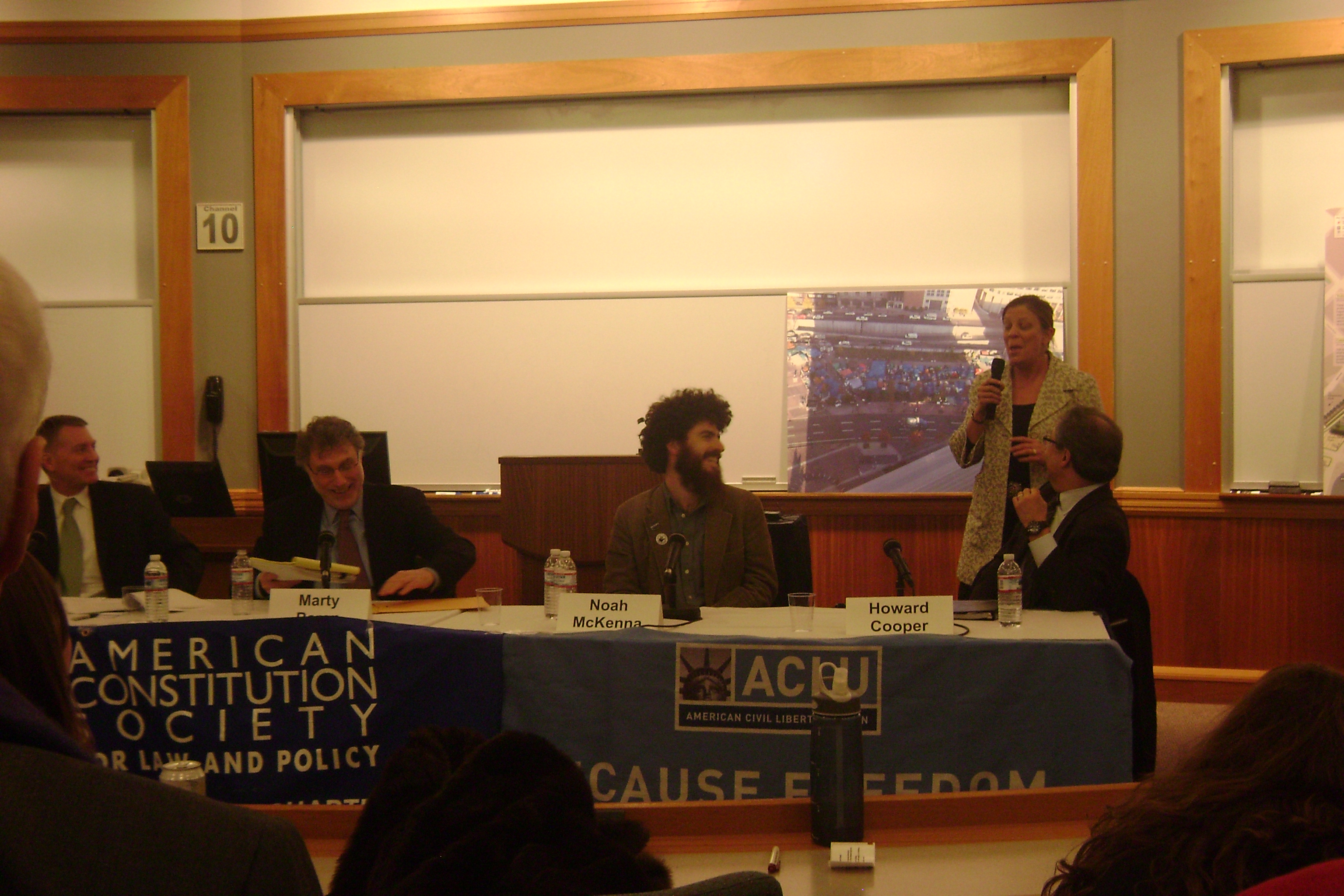
    Bill Sinnott, Marty Baron, Noah McKenna, Carol Rose and Howard Cooper /Photo by Matthew J Shochat

    On February 13th, 2012, at 6pm, inside Classroom 315 at Suffolk University, many law students, Occupy Boston supporters and curious individuals gathered to hear a panel titled “Occupy Boston: The Rise of the Tent City and Its First Amendment Implications,” regarding the legal significance and precedence behind the Occupy Boston encampment and evictions faced throughout it’s existence. Opening remarks covering the history of the Occupy Boston encampment were presented by Carol Rose, Executive Director of the ACLU of Massachusetts, while the Moderator was Marty Baron, Editor of The Boston Globe. The panelists were Bill Sinnott, Corporation Counsel of the City of Boston, Noah McKenna, a member of Occupy Boston and named plaintiff, and finally Howard Cooper, Lead Counsel for Occupy Boston plaintiffs, founding partner, Todd & Weld LLP. This particular event was co-sponsored by the ACLU of Massachusetts and Boston Lawyer Chapter of the American Constitution Society.
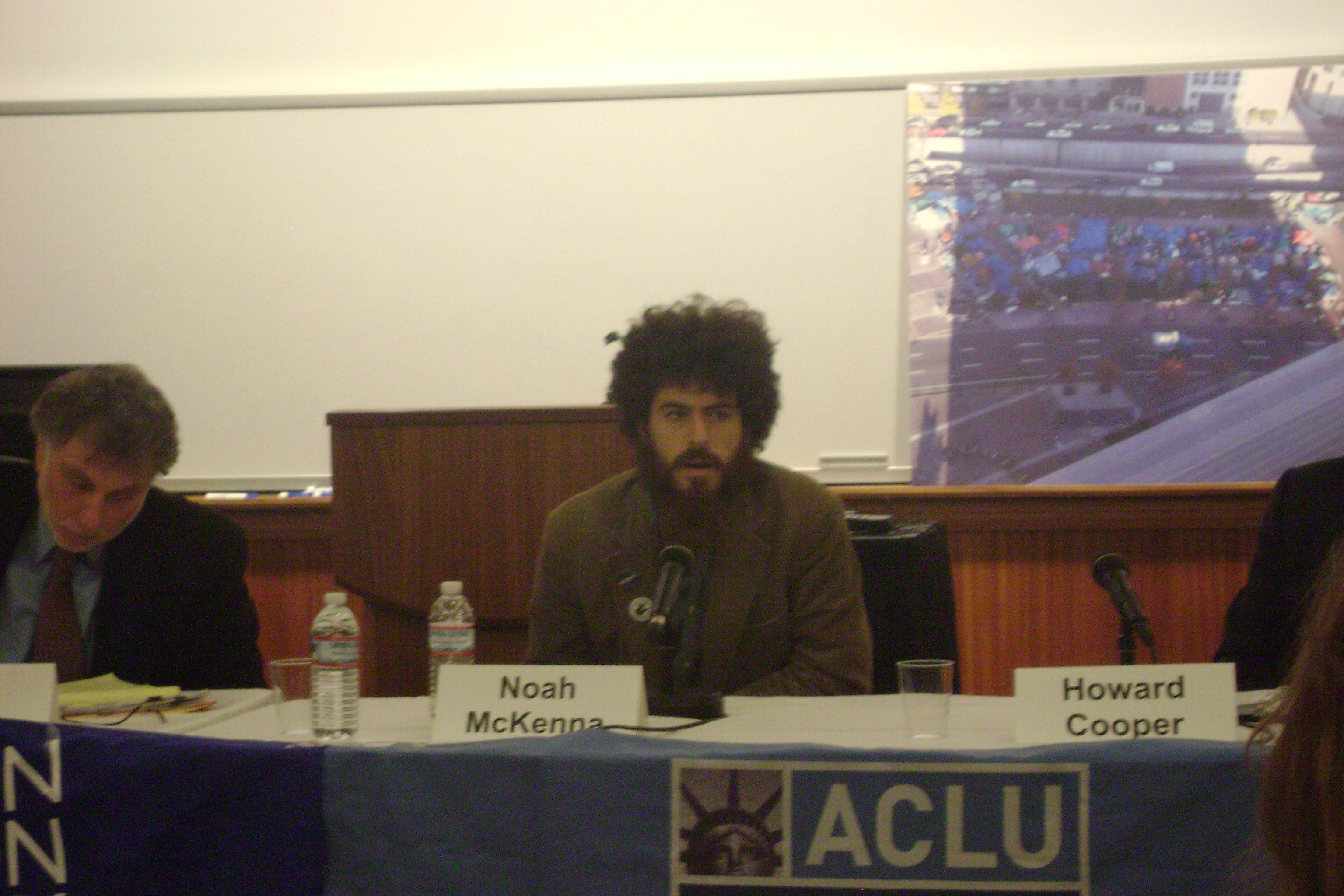
    Noah speaking on the panel /Photo by Matthew J Shochat

    The first in the panel to speak was activist Noah McKenna regarding why exactly he joined Occupy Boston and following such, Bill Sinnott, explained the thoughts and opinions of Mayor Menino and his Administration, including elements taking part during the nights of October 11th and December 10th that resulted in arrests of a total of 179 protesters. Howard Cooper than spoke on what legal basis by which he was defending Occupy Boston in court in favor of their rights. Further into the discussion, the health and safety of the protesters and what they did to meet the requirements of the health and safety officials, which was frequently stonewalled by police during the time of the encampment.

    At some point, a participant asked a question relating to the decision Citzens United vs. Federal Election Commission (2010), which paved the way for the creation of independent expenditure political action committees (or PACs), which overruled Austin v. Michigan Chamber of Commerce (1990) and partially McConnell v. Federal Election Commission (2003), by allowing corporations to fund politicians as a method of “speaking” whereas the protesters who had in court tried to uphold that their actions were fundamentally First Amendments Rights protected by the Constitution.

    Another participant also referenced the recent Montana Supreme Court rejection of the decision on Citizens United vs. FEC, which occurred on Dec 30, 2011, which argues that the U.S. Supreme Court’s landmark decision in Citizens United vs. FEC did not apply to Montana’s century-old ban on direct corporate election spending, due to the state presenting extensive evidence of actual corruption, something of which the U.S. Supreme Court found lacking in Citizens United.

    Due to a class needing the room immediately following the Panel, at 9pm, the crowd quickly dispersed.

    Here is a clip from the panel.
    The OB Media Rundown for 2/16/12

    Longshore workers name Occupy Movement as crucial in settlement with EGT

    On Friday, members of the ILWU and the labor community named the Occupy Movement as key to the settlement reached Thursday between ILWU Local 21 and the Export Grain Terminal (EGT). The contract finally provides for the use of ILWU labor in the grain terminal at the Port of Longview [Washington State]. After staging the December 12 port shutdowns in solidarity with Local 21, the West Coast Occupy Movement planned coordinated action together with labor allies for a land and water blockade of the EGT ship in Longview, should it attempt to use scab labor to load. Occupys in states where EGT’s parent company Bunge has its growth and operations were also planning actions against the company on the day of the arrival of the ship.

    “This is a victory for Occupy in their involvement in forcing negotiations. Make no mistake – the solidarity and organization between the Occupy Movement and the Longshoremen won this contract,” said Jack Mulcahy, ILWU officer with Local 8. “The mobilization of the Occupy Movement across the country, particularly in Oakland, Portland, Seattle, and Longview were a critical element in bringing EGT to the bargaining table and forcing a settlement with ILWU local 21.”

    http://tinyurl.com/6rhvdhd

    With camps gone, Occupiers prepare for new fights

    In interviews with Occupy groups in more than a dozen states – on both coasts and across the Midwest – activists described training for nonviolent confrontation, plans for spring rallies at state capitols and preparations for a major presence at the G-8 and NATO summits to be held in Chicago in May.

    “We have had to get back to more conventional grassroots organizing methods to get more people involved and engaged,” said Chris Schwartz, a member of Iowa’s Occupy Cedar Valley. “What we’re doing is building out infrastructure for the spring.”

    http://tinyurl.com/83uavgq

    What We Owe to Each Other – An Interview with David Graeber

    What we’ve seen over the last 30 years is a war on the human imagination. That’s the other starting point for this book-that in 2008 we had this crash, and all these assumptions we’ve been told we’ve had to accept for 30 years came crashing to the ground along with the market. One of them is the assumption that markets are actually self-sustaining. Obviously not true. Another one was that the people running them are competent. For years we were told that they aren’t very nice people-they’re greedy bastards, actually-but they know what they’re doing. All other systems just don’t work. These guys are incredibly bright, they’re incredibly competent. No, it turns out actually that they don’t even understand the working of their own financial instruments, or as far as they do, they’re engaged in scams. They trashed the entire system.

    Assumption number three is that all debts ought to be repaid. Actually, no, debts don’t really need to be repaid, because AIG, who owes money, can wave a variety of different magic wands and debts can be made to disappear. Once you understand that the narrative we’ve been handed has been false, you’d think this would be the moment when you start thinking about larger questions: Why do we have an economy? What is debt? What is money? How could these things be organized differently? What do we need to keep and what do we change? You would think this would be the moment for international discussion about the basic assumptions that we’ve been making, and it seemed for about two weeks that it was going to happen.

    http://tinyurl.com/77gnka9

    Continue reading »

    Occupy Boston Student Summit a Success

    Photo Essay By Forest and Chase
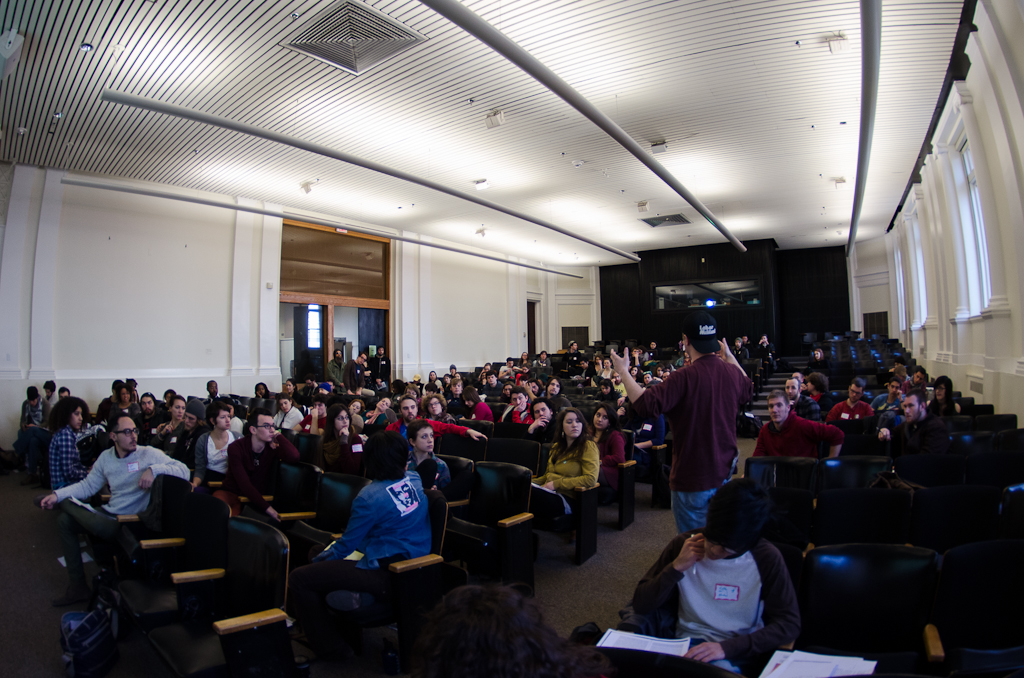
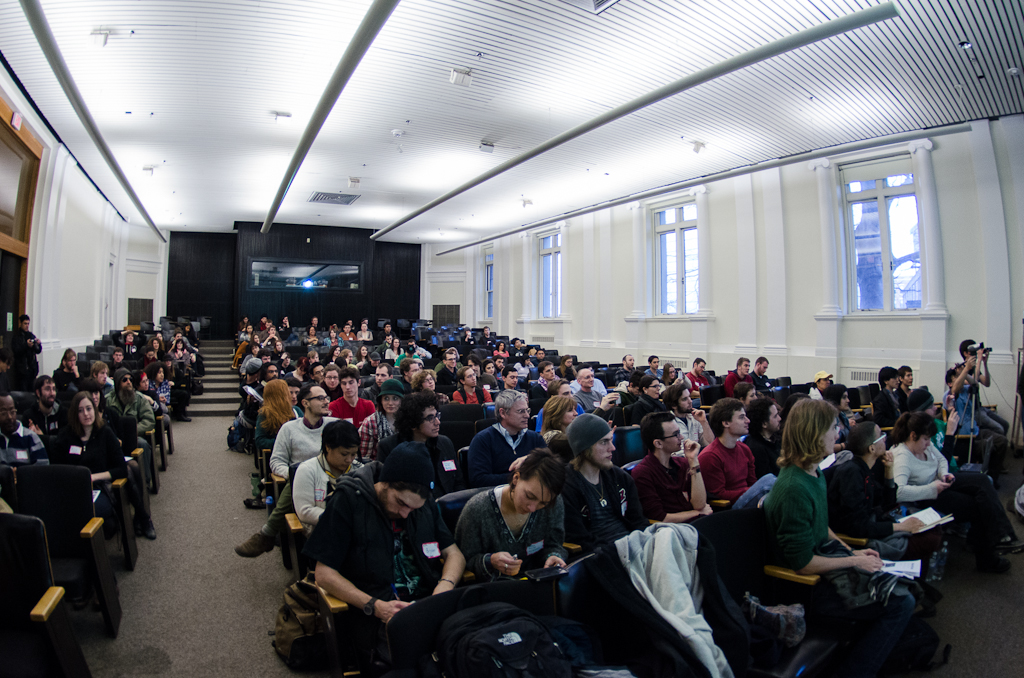
    The Occupy Boston Student Summit this past Sunday (the 12th) was the first time the many Occupy student groups in Boston convened in one, large space outside the context of a general assembly.
    Held in a philosophy building near Harvard Yard, the summit saw more than a hundred attendees from over a dozen schools both in the area, and as far away as Vermont.

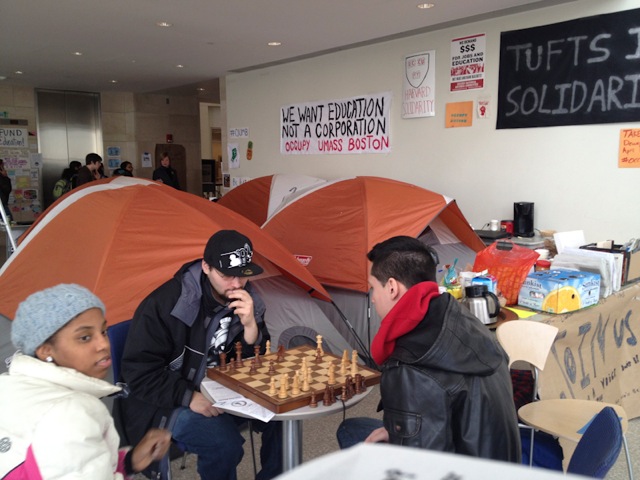
    This actually isn’t at the summit. This is UMass Boston, where students have set up a small tent city inside their student center to fight the increasing privatization of the supposedly public university. This is the back of the camp; the front area with a table and literature is in the background of the photograph. This photograph was taken the day that Occupy UMass Boston mic checked the board of trustees that was meeting a floor above the camp.
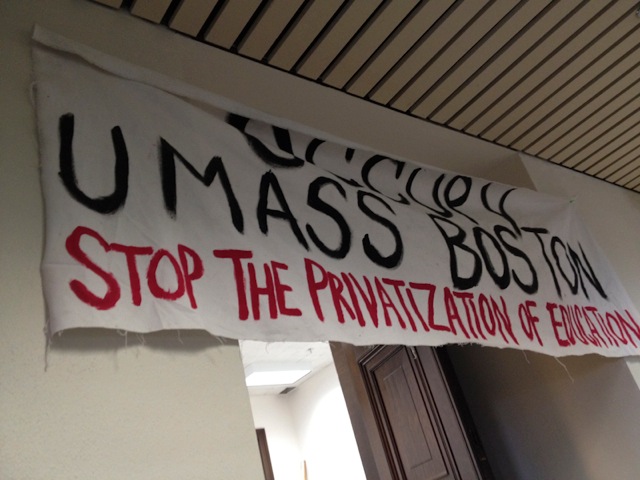
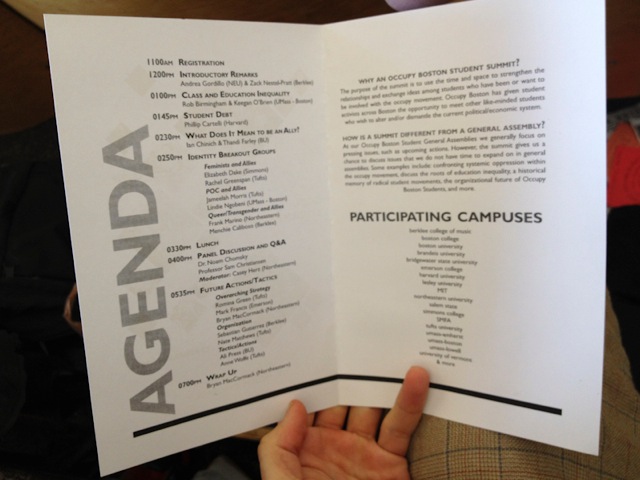
    Banner from UMass Boston hanging over one of the conference rooms at the summit, which was located at Harvard. Other schools represented in the attendees included Tufts, MIT, SMFA, Lesley, Northeastern, Berklee, Boston College, Emerson College, Bridgewater State University, Bennington College, Massachusetts College of Liberal Arts, and many others.
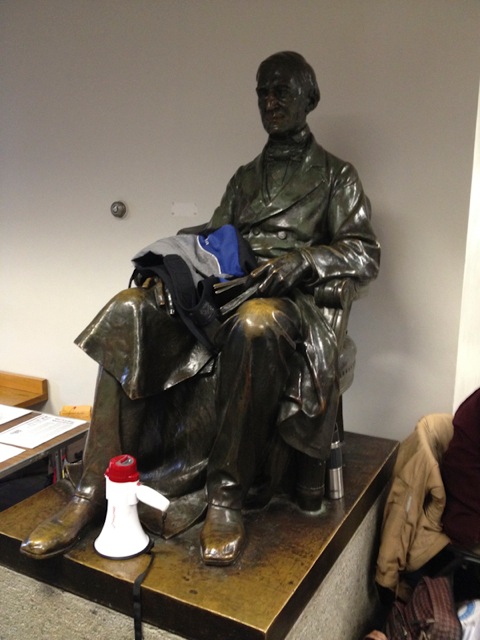
    I was really hoping Emerson would come to life and pick up that megaphone.
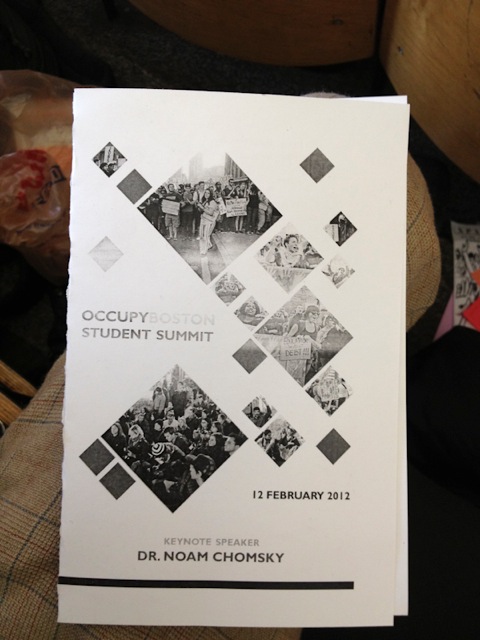
    Lovely program.
    The eight hour conference passed rather quickly. The day began with a group speak-outs on class and education inequality, and another on student debt. Soon following those were identity breakout groups in which separate spaces were given to discuss and contemplate particular conditions of oppression facing women, people of color, and queer/trans people with insight to how these might be understood within the student community of Occupy Boston. The day ended with a Q&A panel, followed by planning for future actions/tactics.

    Photo By Chase C.

    Photo by Chase C.

    Photo By Chase C.

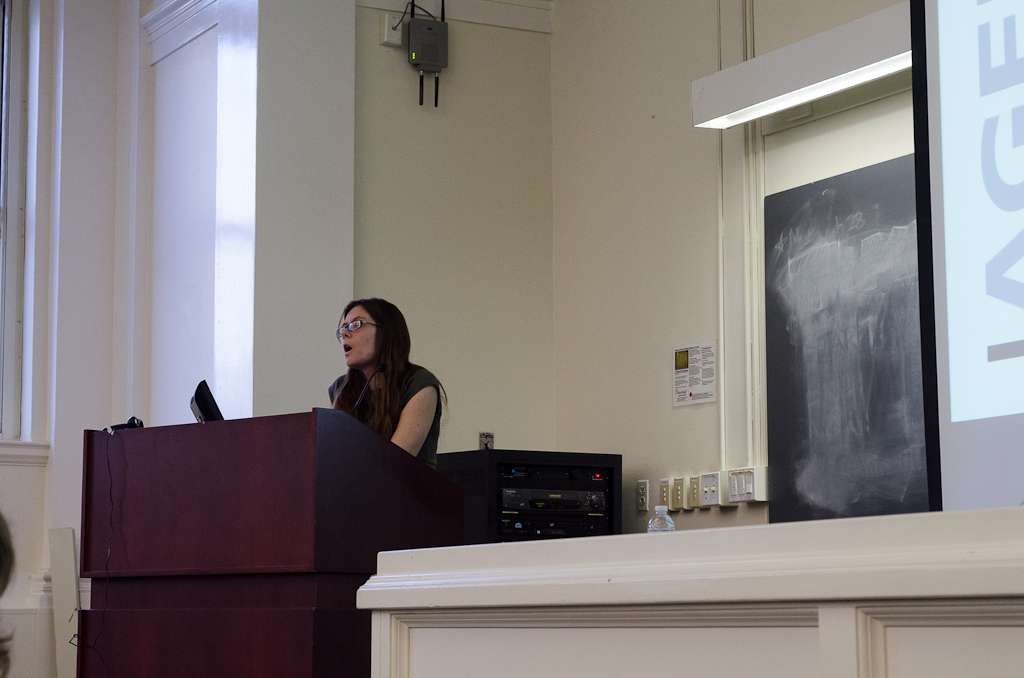
    Professor Sam Christiansen from Northeastern gave a riveting talk addressing the history of student movements, and the continued revolutionary potential of student activism in society today. Christiansen said that students as seekers of truth are in the right place to directly act on society. She encouraged students to start cross-campus reading groups and to think of activism as a central aspect of education. She reminded us of events in the 1960s such as when students and workers united to shut down Paris, the release of the Port Huron Statement, and worldwide changes arising from the universities—finally concluding that these cannot be so much models to follow as things to remember and be informed by.
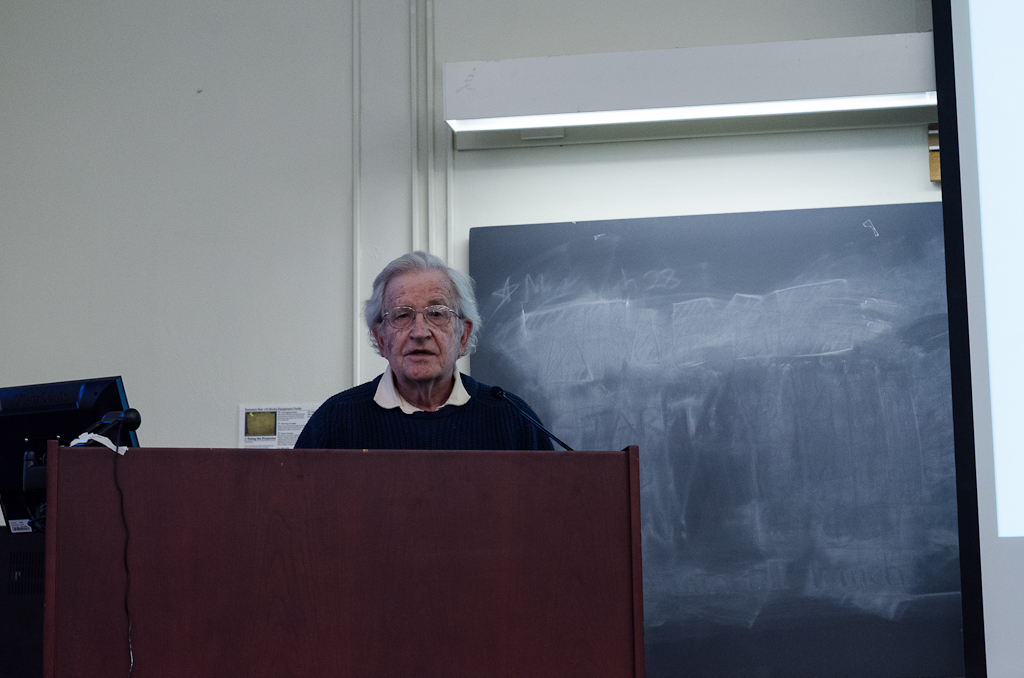
    Noam Chomsky spoke afterwards. Chomsky’s presence at the summit (it’s rumored) was not widely publicized so the event wouldn’t get flooded with non-summit participants. This meant it was really just him having a conversation with us, which was very nice. His talk addressed some of the causes for present restructuring of universities in the image of the corporation. Chomsky spoke about the present—and past—relationships between education and business in America, pointing to Lewis Powell’s 1971 memorandum to the U.S. Chamber of Commerce which more or less points toward the present situation <http://reclaimdemocracy.org/corporate_accountability/powell_memo_lewis.html>. He also drew attention to other countries such as Mexico that have maintained a free university system precisely through student strikes and struggle against privatization.

    Photo by Chase C.

    Here’s the video of Christiansen’s talk followed by Chomsky’s:

    Watch live streaming video from occupyboston at livestream.com
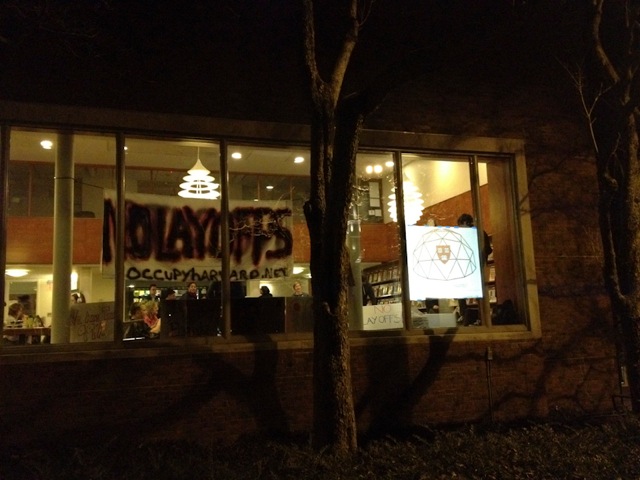
    During the summit students from Harvard occupied the Lamont Library to protest a set of proposed cuts in staff across the whole university’s library system. They are going to stay there for five days, at least.

    No Layoffs Campaign – Picket at Harvard!

    TOMORROW (Thursday 2/16) 5:30pm
    Lamont Library, 11 Quincy Street, Cambridge, MA 02138

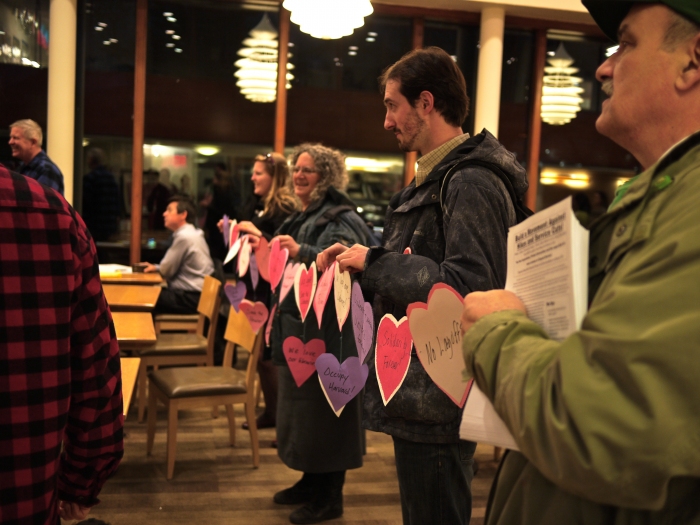
    Library workers present Occupy Harvard a Valentine's Day card
    Library workers present Occupy Harvard a Valentine’s Day card
    The No Layoffs Campaign will picket outside of Lamont Library, the undergraduate library where Occupy Harvard has set up its temporary, targeted occupation, to call attention to the University’s draconian policies.
    Harvard’s libraries are still reeling from the staff cuts of 2008. That the library “restructuring” involves buyouts & layoffs has come as a shock to many who say that their departments are already incredibly understaffed.
    The Harvard administration has announced a plan to restructure the library system that will make libraries “more efficient” which will include a “smaller workforce.” The jobs of hundreds of staff currently employed by the libraries are threatened; measures include cuts and restructuring by “voluntary and involuntary means.” High unemployment rates make finding a new job nearly impossible, especially for older workers, who are being incentivized to leave “or else.” Harvard’s endowment grew 21% last year, to $32 billion, and the library operating costs represent only 3.3% of the annual budget.
    Support the union of clerical workers and nonunionized Harvard employees, including our research librarians!

    The OB Media Rundown for 2/15/12

    Straight A’s and a Staunch Supporter of the Occupy MovementCall me a radical, call me a hippie, call me a socialist, anarchist, liberal, even a communist – but what I am is a human being who is speaking out and acting out against economic and social inequality.

    http://tinyurl.com/6slbtgd

    Hundreds Rally Against MBTA Cuts, Pack Meeting

    The proposed MBTA fare hikes_ fall disproportionally on the elderly, disabled, student and low income population, many people said at a packed-to-capacity public hearing Monday night.

    Following an Occupy Boston rally at Copley Square hundreds of people – many of them college students – flowed into the Boston Public Library. They filled the 342-seat auditorium and 110-seat overflow room by 6:05 p.m.
    “Some people got here at 4:30,” a library worker said.

    Officials began turning away at least 100 people lined up inside the foyer, and promised to add more public hearings to the _already lengthy list_.

    http://tinyurl.com/6sjpfal

    The Fight Against MBTA Service Cuts and Fare Hikes Gets Ugly

    The latest theater in the war against MBTA fare hikes and service cuts opened Monday with a bang on every corner of the train map. Occupy Somerville forces rallied in Davis Square. Their Jamaica Plain and Dorchester counterparts gathered at Forest Hills and Fields Corner, respectively, to sound alarms about troubling proposals. Leading the pack, a group of loud and determined teens with the Youth Affordabili(T) Coalition joined hundreds from the T Riders Union (TRU) and other activist outfits for a mass rally on Copley Square outside the Boston Public Library, where the MBTA planned a bombshell public meeting for 6pm on Monday night.

    http://tinyurl.com/6qqw3r4

    Continue reading »

    Contact us

    Occupy Boston Media <Media@occupyboston.org> • <Info@occupyboston.org> • @Occupy_Boston